Wednesday, February 25, 2009

Slipcover Progress: Putting it together

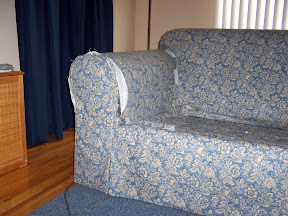
Last time, I had cut and pin-fit all the sections of the slipcovers, but didn't have any photos to share. Here are a few photos of the pin-fitting progress:

left inside arm; right arm front, with piping attached and pre-finished skirt:

right outside arm - pre-finished skirt:


the whole thing pin-fitted:


Finally, I was ready to start pin-basting and putting the slipcover together.

Starting with the inside back, platform and front skirt sections, I pin-basted the sections together along the intended seam line. I used a water soluble pen to mark the pinned seam, then sewed the sections together. The seam that joins the inside back and platform sections allows a 5-6 inch "tuck-in"; the seam is not sewn tightly into the corner but instead leaves this extra fabric for ease. It is tucked in between the space between the couch's upholstered inside back and platform area when fitting the slipcover to the sofa.

The next sections pin-basted were the inside arms to the inside back and platform. I allowed a tuck-in allowance between the inside arm and platform for fitting. Sewing these two seams was a bit of a challenge, because I wanted to leave enough ease for the tuck-in areas while making sure the seams met in the intersection of the three areas. I had to make a few alterations, but eventually, it all worked out. After sewing each section, I tested the fit on the couch before trimming and clipping the seams, then moving on to the next section.

The original couch upholstery features "faux box pleats" -- instead of real box pleats, there are are series of underlay sections stapled to the frame of the couch; the upholstered cover has skirted sections that lay over these sections and give the appearance of box pleats (see my previous blog entry). My new slipcover is mimicking this effect.

To achieve the look of the faux box pleats, the front skirt sections as well as the outside arm, arm fronts, underlays and back are all pre-finished lined units that needed to be assembled before pin-basting or sewing. For most of these sections, I used a heavy weight muslin for the lining and mitered the corners.

To make each unit, I cut the muslin lining one inch shorter on 3 edges - the two side seams and the bottom. I sewed with a 1/2 inch seam allowance along the two side seams, aligning the top edges and stopping 1/2 inch from the bottom of the lining. Then they were turned right side out and pressed so that the front wrapped around the back by 1/2 inch on each side.

To make the mitered corners and sew the bottom seam, I turned the unit so that the wrong side faced out and pinched the corner of the longer front fabric to form a triangle. Turning and folding the triangle away from the side seam pulled the bottom of the front and back fabrics even with each other:


I pinned the bottom seam and stitched between the side seams, using a 1/2 inch seam allowance:


I turned the triangle out to the side again and stitched it flat and trimmed off about one square inch:


Last, I turned the unit right side out and poked the corners until they were just right and the seams inside were nice and flat, then pressed the corners and seams really well. Here's a peek at a couple of the finished underlay sections:


I continued pin-basting and sewing all the sections of the couch except for the back, then tested the fit again, tucking in all the seams where necessary:


Here's a close-up of the left inside arm area and Keli inspecting the fit of the right outside arm (underlays are pinned in place):


Finally, I pin-fitted, basted and sewed the back section:


The curves of the back seam where not easy to line up correctly on my first pass and need to be adjusted a little. There's a little too much fullness and the tucks are not as tight as I'd like, so I need to re-stitch some sections. I've pinned the adjustments below:


Before making any further adjustments, I wanted to see how everything looked with all the cushions in place to check for any gaps or pulls:

The pillow is borrowed from another room; but so far I'm rather pleased with the overall result. I need to do a little more tweaking on the back and add a few final touches, but this project is about 95% complete!

Pin-basting and sewing took me three days - Sunday through Tuesday. I should have the final adjustments finished by Friday.

Next time I'll share a few finishing touches before wrapping up this project.

To see all the photos of this project, visit my Slipcovers Picasa photo album

Saturday, February 21, 2009

Slipcover Progress: Cutting and Pin-fitting

This is an update of my ongoing Slipcover project; my previous entry about completing the cushions can be found here.

My sewing area has been relocated to the dining room:


I spent most of the afternoon on Thursday sketching the various sections of the couch and calculating the size of the fabric pieces needed for each, just to make sure I would have enough yardage. This also helped me decide just how to tackle the box pleats without making a separate skirt for the couch.


The instructions for making a basic slipcover in my sewing reference assumes the slipcover will be either skirted or faced; my cover is neither. Notice in the center front and on either side of the arm fronts (as well as both back corners), there are what appear to be box pleats. These are not real box pleats; there are a series of "underlays" stapled to the frame in each section and the corresponding "overlays" are simply lined skirt sections.

In trying to recreate the original look of the couch, I've concluded that my new slipcover must be semi-upholstered, in a manner similar to the original upholstery. For weeks I've been trying to come up with a way to make real box pleats without making a separate skirt and I just couldn't figure any way to accomplish the look I wanted. So, I'm making faux box pleats instead.

Here's a look at a few of the "underlay" sections on the original upholstery:

The center front pleat


The front right corner has two underlay sections


This is the back corner, normal (left) and underlay exposed (right)

In order to make the faux box pleats work, I'm finishing each "skirted" section as a fully lined unit during the pin-fitting phase of the project, which means this is taking me about twice as long as it would if I had just made a plain old skirted slipcover. Ah well, maybe next time I'll go the easy route.

On Friday, I did a rough cut and pin fitting of all the pieces. For the inside and outside back and the platform sections, two widths of fabric had to be carefully pieced so that the seam would fall in the center of the sofa *and* making sure the pattern would match.


Those center seams look pretty good, if I do say so myself. Fortunately, with this fabric the overall pattern repeat is not too obvious.

By the end of the day, I had the inside back, platform and two front skirt overlay sections finished and pinned in place.


To fit the back shoulder, I pinned a few tucks:


On Saturday, I finished pinning the inside arm sections and made the outside arm skirt overlays and arm front sections. Next, I'll be making all the underlay pieces and the outside back, before pin basting and finally sewing all the pieces together. I'll have photos of these steps next time.

As I mentioned last time, there are lots more photos of this project in progress in my Slipcovers Picasa photo album.

MEET THE METS (1962) Baseball Theme Song

Taking a short break from my slipcover project . . . this Meet the Mets video made me smile.

Watch a photo montage while listening to two (or three?) verses of the original Meet the Mets theme song, followed by Bob Murphy's introduction of the Mets' first ever opening day game lineup versus the Cardinals in 1962.

Thursday, February 19, 2009

Slipcover Progress: Cushions are Done!

This month's big project is making slipcovers for my old couch and ottoman. The ottoman turned out quite well and has survived several weeks of Westie play- and naptime.

For the sofa, I decided to begin with the cushions for a few reasons:
  1. They are portable, so I can carry them upstairs to work on them in my sewing room.
  2. Most of the piping on the covers is on the cushions, so I can get that task out of the way early.
  3. I've made cushion covers in the past and feel more confident in putting them together first.
I started with the seat backs because I thought the curve on the arm edges would be more challenging than a simple box.


I had some "help" right away:


I want to be able to machine-wash these slipcovers so before cutting out any pieces, I pre-washed and dried my fabric in 5-7 yard sections. While waiting for the pieces to dry, I gathered up some supplies.

For a sewing reference, I use Simplicity's Simply the Best Home Decorating Book, which I've had since about 1995. The cover photos are somewhat dated, and I would guess the book has been updated sometime in the past 15 years. The basic instructions for making everything from window treatments to bedskirts to slipcovers are included in this manual.


A few months ago I ordered 50 yards of cotton piping (a home dec notion) and a Make-A-Zipper roll from Joann.com, during their Merry Moolah sale.

One of the cuts of fabric was a 2 yard piece, which I used to cut bias strips for making the piping. Each cushion required two lengths of piping at just under 120 inches each; that's 960 inches total or just under 27 yards of piping for the cushions.

I cut the bias strips at 1-1/2 inch width, as I was trying to be frugal; 1-3/4 inches would have been a little easier to work with and I would have had plenty of bias to work with. The bias strips were pieced to make sections a little longer than 120 inches each.

To make the piping, I cut lengths of cotton cord about 120 inches long. I folded the bias strips in half lengthwise and pressed them lightly with iron, then placed a length of cord inside the strip along the fold and pinned the raw edges closed. Then I stitched them closed using a single welt cord foot. This foot has a groove on the bottom that slides along the cord and helps keep everything straight -- a very helpful tool to have when making nearly 30 yards of piping!

After the piping was finished, I cut out all the pieces for the back cushions. I removed the old cover from one of the cushions and used it as a pattern to trace the cutting line onto my new fabric. Then I cut and pieced together the boxing strip, including a 42 inch zipper section, for each cushion.

To apply the piping, I pinned and then basted it along the edge of each cushion front and back. The single welt cord foot helped out again as I sewed (I adjusted the needle position 1.5 to the right). Last, the boxing strip was attached to each side of the cushion (with the zipper open slightly for turning), still using the single welt cord foot and with the needle position at 1.0. It was a little tricky going around the curves, and I had to rip out and re-stitch a few sections. To join the raw edges of piping, I simply overlapped them at a lower corner and cut away the cording inside. I didn't want to be bothered with making a "pretty" joining since this part of the cushion won't be visible.

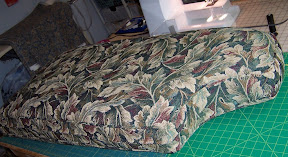
It took two days to complete the back cushions:


The seat cushions were next, and I followed the same process, thinking these were going to be much easier, being a simple shape. I cut a rectangle based on my measurements, but I should have traced them for a better fit of the curve of the piping at the corners. As a result, I ended up pin-fitting the pieces to each cushion before sewing them (sorry - forgot to take a photo of that step!) and spent way too much time ripping and re-sewing the corners. Eventually everything worked out and I have a pair of fairly good-looking cushion covers (which also took me about two days to finish):


I had some help from Penny with the seat cushions, too -- guess where she's sleeping:


Maybe she's keeping it warm for me while I work:


I still need to serge the seams for a nice clean finish to prevent fraying. I may wait until the very end so I can do all my serging at once.

Next, I'll be starting on the body of the couch slipcover. There's a little bit of piping on the arms, and I'll have to match and piece several widths of fabric together to fit the width of the sofa before pin-fitting any of the pieces. This will be the more challenging part of the project -- not that the cushions were easy.

I'm planning on moving my sewing machine and tools to the dining room for this next phase so I don't have to go up and down the stairs too often. I expect this will take about 2-3 more days, at least.

You can see all the photos from this project in my Slipcovers Picasa photo album.

Wednesday, February 18, 2009

Thankful Heart Banner (another detour)

One more small detour before getting back on track with the couch slipcovers:

Thankful Heart Banner

I was on a roll with Valentine decorating and remembered this Thankful Heart design from Embroidery Library from a while back. The design is machine embroidered on a scrap piece of linen-type fabric and it was finished as a small banner using scraps of fabrics from my stash. I stitched in the ditch around linen section for the "quilting".

I'm not sure I framed the fabric sections "correctly" -- maybe the longer sides should have been horizontal? Or maybe I should have tried to "log cabin" them. As it is, it makes a nice mini banner to hang on the front door.

Next month, I plan to make a St. Patrick's Day companion piece using another EL design, entitled "Best Friend & Four Leaf Clover". I already have the linen-type fabric ready to go, I just need to decide which green fabric to clear out of my stash for the borders and backing.

Until then, I'm back on track with the slipcovers.

Friday, February 13, 2009

Happy Valentine's Day


Valentine's Day 2009, originally uploaded by SewWestie.

Keli & Penny wearing their fancy Valentine ruffles; visit Keli's Korner for the full slideshow.


Valentines Past

Working on the Heart Runner/Mini Quilt last week reminded me of some of my old Valentine's day needlework projects, so I thought this would be a good opportunity to share some of them here on the blog.

Below is stitched from a free Christmas Angel (1996) pattern from Lavender & Lace:


Even though it is a Christmas design, I display it for Valentine's Day because of the heart shape and roses surrounding the angel.

Also stitched in 1996 is this bellpull, from Emie Bishop's book Joyous Occasions:


This one isn't strictly a Valentine design either, but it has the hardanger heart design at the bottom, so I consider it part of the Valentine decor.

Next, "Be Mine, Valentine", was a chartpack from A Stitch in Time, completed in 1997. When the band sampler was complete, I finished it as a another bellpull:


In 2000, I participated in a Valentine's Day exchange in my local EGA chapter; I received this heart-shaped box filled with chocolate kisses, covered with Lizzie*Kate's Love is Best:


Next, a kit called "Red Heart" from Heart in Hand Needleart which I completed in 2004:


I like the tiny pillow insert and the fact that it has shamrocks on it, so I can leave it on display for both Valentine's and St. Patrick's Day.

Here's another kit from Heart in Hand Needleart called Valentine Roundabout, I completed it in 2006:


The kit included the linen fabric, thread and charm. When it was finished, I mounted the completed cross stitch piece to the lid of a paper mache box and covered it with coordinating fabrics and trims. Later, I machine embroidered an insert for the inside of the box:


Another project completed in 2006 was started at an EGA meeting in 1997:


These "chocolates" are made of ribbon!

In 2007 I embroidered by machine more than by hand:


These are in-the-hoop gift bag designs purchased from Embroidery Library.

That brings us up to date -- Happy Valentine's Day!

Here's a link to more of my Valentine projects (OPF)

Related Posts Widget for Blogs by LinkWithin